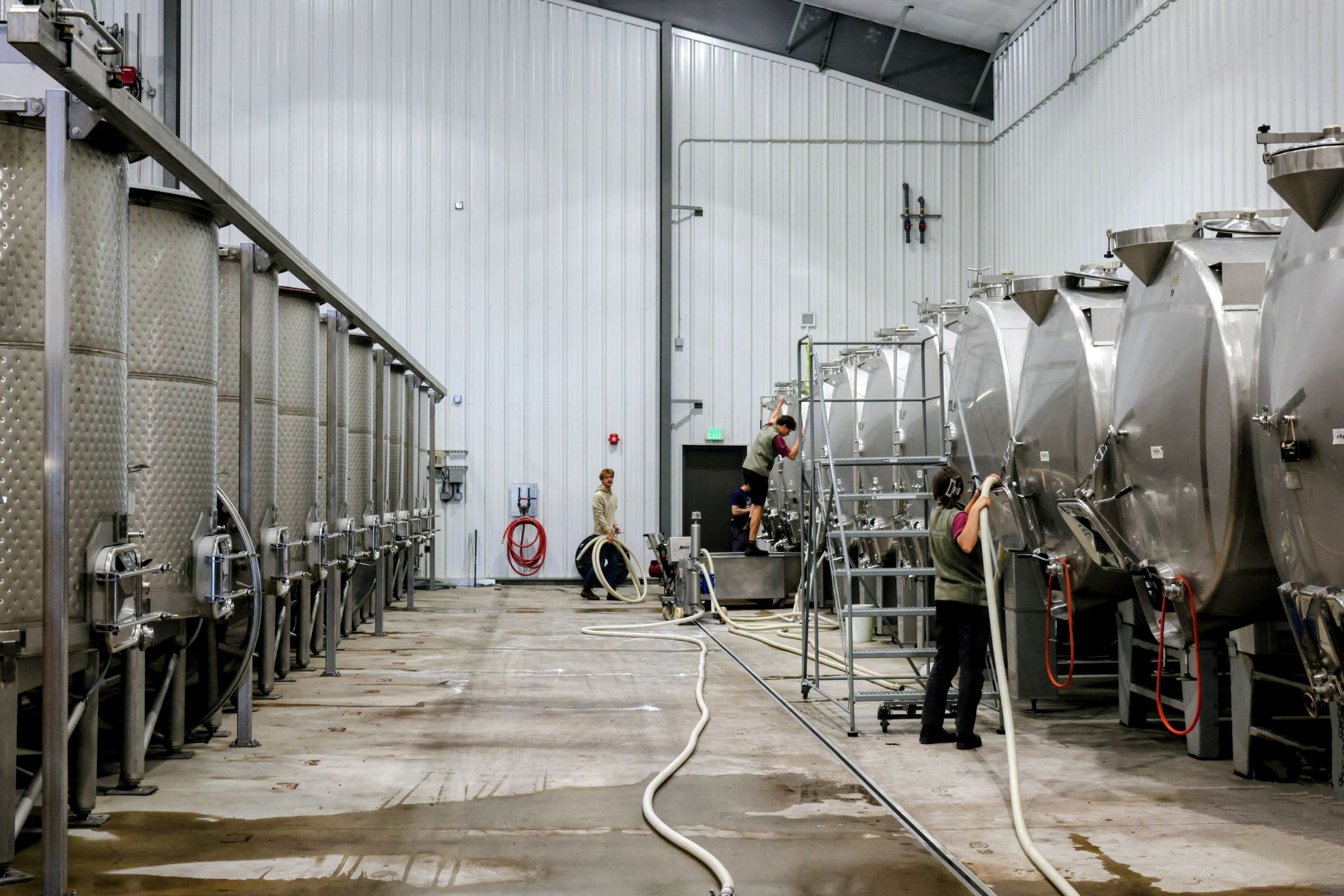
The tanks at Résonance Winery.
Metamorphosis Through Fermentation
It’s a tale as old as time. For as long as humans have been on Earth, they’ve used fermentation to transform one food into another. The earliest known wine fermentation occurred in Georgia, in clay pots, around 6000 BC. Originally used primarily to preserve food, fermentation continues today as cabbage becomes kimchi, cucumbers become pickles, and grapes become wine.
The Harvest in Retrospect
Today, winemakers around the Dundee Hills are sitting on the other side of their harvests. The vineyards, recently laden with fruit, are now bare as leaves turn golden and fall to the ground.
During the peak of the Résonance Winery harvest, the team ran 12- or 13-hour days, picking by hand and processing Pinot and Chardonnay across their vineyards, all dry-farmed and certified organic, including their 15-acre estate in the Dundee Hills and three others spanning nearby AVAs within the Willamette Valley.

Fermentation Begins
The fruit at Résonance Winery has been fermenting since nearly the moment it arrived from the vineyard. Depending on the grape varietal, winemakers either destem or press the grapes before they enter a fermentation tank. The former keeps the grape skins in contact with the juice, adding flavor, acidity, and color. The latter keeps the juice entirely separate from the skins.
The tanks with Pinot Noir need regular attention for “cap management”. As the grapes ferment, the CO2 produced pushes the skins to the surface, where oxygen exposure can become problematic. The solution is punchdowns, which submerge the cap back into the juice, or pumpovers, which pull juice from the bottom of the tank and pump it back over the skins.

Fermentation for Pinot Noir versus Chardonnay
Résonance is a winery inspired by and linked to Burgundy, producing only Pinot Noir and Chardonnay.
The winemaking team keeps the destemmed Pinot Noir berries in stainless and wood tanks and on the skins for about three weeks, which Assistant Winemaker Jared Coon, says is on the longer side of typical. Once the wines are released from the tanks, the skins are pulled out, pressed again, and reunited with the wine in another tank to settle for two days before the finished, clear wine is racked off, meaning it’s moved into barrels to age in the cellar for about 18 months.
Chardonnay moves much quicker. The grapes are pressed immediately, and the juice settles in a tank for one or two days before being racked off heavy lees, which consist of insoluble dead yeast cells left behind after fermentation converts the grapes’ natural sugars into alcohol. During fermentation, the wine goes into French oak barrels or concrete eggs, where it ferments for a couple of weeks or months. It stays in that same vessel for about 15 months before bottling.
Résonance uses French oak barrels (all Cadus barrels) and concrete eggs for Chardonnay, with the latter offering natural convection due to the shape. In an egg, the wine stays in perpetual motion, increasing interaction with the lees as they break down, creating a rounder mouthfeel and releasing different flavor components throughout. The winemaking team will blend the wine from the concrete eggs with the wine from oak barrels before bottling.

Intervention, Restraint and Creativity
Winemakers consistently battle their own instincts as they watch and wait for wines to ferment. Sometimes a ferment will pause entirely for days before restarting and completing the natural processes without human intervention. Other times they will need a boost. Coon notes that this year’s wines have had clean ferments from start to finish, with no awkward pauses among them, and he’s extremely optimistic about the vintage overall.
Résonance draws on Maison Louis Jadot’s Burgundian experience, where winemaker Guillaume Large served as Maitre de Chai before moving to Oregon, to reveal the unique expression of each place. Using the same winemaking approach for each origin, Résonance believes this is the best way to highlight the diversity of the Willamette Valley’s terroirs.
What Comes Next
The Résonance winemaking team expects two more weeks of cellar work as they drain, press, and clean the tanks. From there, the wines will stay tucked away in the cellar to age until it’s time to blend and bottle.
The surrounding vineyards will lie dormant, and pruning will begin in the early part of next year before the first buds start to appear in early spring and the next vintage gets underway.
Résonance Winery’s Dundee Hills tasting room is open Thursday through Monday in the southern part of the Dundee Hills AVA. Neighboring vineyards include those belonging to Domaine Drouhin Oregon, De Ponte Cellars, and White Rose Estate.